
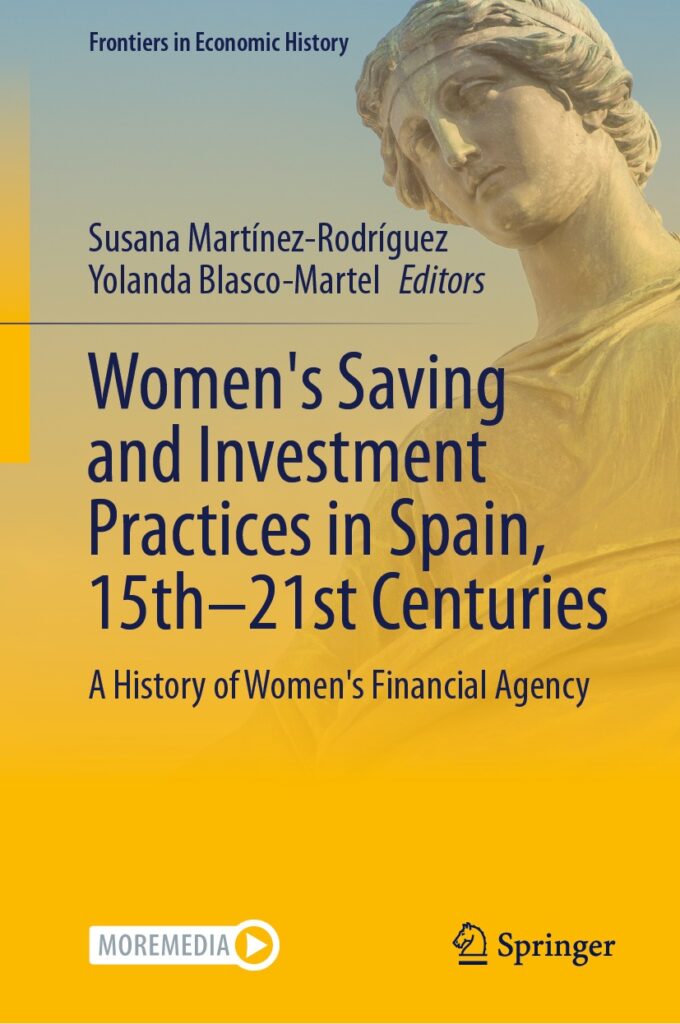
Women’s Saving and Investment Practices in Spain, 15th–21st Centuries: A History of Women’s Financial Agency
Edited by Susana Martínez-Rodríguez and Yolanda Blasco-Martel
Martínez-Rodríguez, S., & Blasco-Martel, Y. (Eds.). (2026). Women’s saving and investment practices in Spain, 15th–21st centuries: A history of women’s financial agency. Springer. https://doi.org/10.1007/978-3-032-33206-6
This volume offers a long-term history of women’s financial agency in Spain, from the fifteenth century to the present. Bringing together specialists in economic history, business history and gender history, the book examines how women saved, invested, inherited, managed property, participated in financial markets and made economic decisions within households, firms and families.
The chapters challenge the assumption that women remained marginal to financial life until the contemporary period. Instead, they document a wide range of practices through which women accumulated, preserved and transferred wealth, adapted to changing legal and institutional frameworks, and participated in banking, commerce, entrepreneurship and investment.
By combining evidence from different regions, periods and types of sources, the volume highlights both continuity and change in women’s relationship with money and financial assets. It also shows how legal constraints, family strategies, social norms and access to information shaped women’s economic opportunities over time.
The book contributes to a broader reinterpretation of financial history by placing women not at the margins, but at the centre of processes of saving, investment and wealth management. It will be of interest to scholars and students of economic history, financial history, business history, gender studies and the history of institutions.
Published in the series Frontiers in Economic History – Springer.
Order now: https://link.springer.com/book/9783032332059#accessibility-information
About the Editors
Susana Martínez-Rodríguez is Full Professor of Economic History and Institutions at the University of Murcia, Spain. Her research focuses on women’s roles in business and finance from a historical and comparative perspective, highlighting their contributions as shareholders, investors, and asset managers in modern Spain. She combines quantitative and qualitative methods to explore how financial culture, family, law, and gender intersect. A leading voice in feminist economic historiography, she has led major research projects and published widely in top academic journals. This book reflects her long-standing work uncovering gaps in Spanish economic history through the lens of women’s financial inclusion.
Yolanda Blasco Martel is an Associate Professor of Economic History and Institutions at the University of Barcelona, Spain, and a leading expert in Spanish financial historiography. Her research has shed light on the development of banking, credit, insurance, and taxation, with a focus on how financial institutions shaped Spanish capitalism. She has published widely in national and international journals, offering a distinctive perspective that blends social and institutional analysis. Her work has significantly influenced the field by highlighting the broader societal impact of financial systems. As coordinator of this volume, her expertise brings a fresh and essential view of Spain’s financial past – one that centers the often-overlooked role of women in shaping economic history.
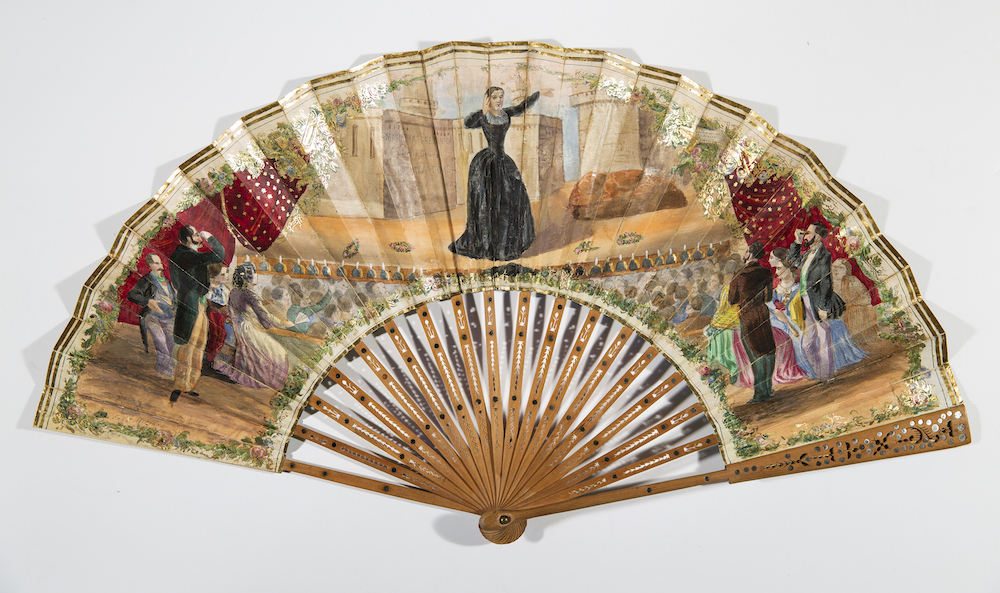
Fábrica Francisco Mitjana. (ca. 1854). Abanico [Fondo museográfico CE2477]. Museo Nacional del Romanticismo, Madrid. Fotografía de Javier Rodríguez Barrera.
Links:
Ficha del abanico CE2477 en CER.es, catálogo del Ministerio de Cultura
Comentario del Teatro Real sobre el abanico y Marietta Gazzaniga en Il trovatore
Women’s Saving and Investment Practices in Spain, 15th–21st Centuries: A History of Women’s Financial Agency is structured around the metaphor of a fan. Its ribs, folds, and leaf represent the different chapters, periods, and experiences that make up women’s financial history. Each part has meaning on its own, but only when the fan is fully opened does the broader picture become visible.
To carry this idea into the visual identity of the volume, the editors selected a fan from the collection of the National Museum of Romanticism in Madrid, which holds an important collection of these objects. The piece, cataloged as CE2477 and produced by the Francisco Mitjana Factory around 1854, combines wooden ribs with a paper leaf decorated with pigments and sequins. One side of the fan depicts the celebrated Italian soprano Marietta Gazzaniga during a nineteenth-century performance of Giuseppe Verdi’s Il trovatore.
The image connects the material structure of the fan with the purpose of the volume: to bring together different chapters and perspectives in order to unfold a long-term history of women’s saving, investment, and wealth management practices.